Data have moved to the centre of social and economic relations. They do not only describe the world, they also make it.
Professor of Information Systems, ESSEC Business School
Cristina Alaimo is Professor of Information Systems at ESSEC Business School, Paris, in the Department of Information Systems, Data Analytics and Operations. For fifteen years her research has traced the relation between data and socio-economic practice, arguing that data are produced rather than found. Her current work presses the claim further: through the categories, technologies, and models that produce them, data have come to make the very world they describe — composing the objects that organisations and markets act on. The claim is developed in Data Rules: Reinventing the Market Economy (MIT Press, 2024, with Jannis Kallinikos), winner of the EGOS Book Award 2025 and available open access, and in work published in Organization Science, Organization Studies, the Journal of Management Information Systems and the Journal of Information Technology. She is Senior Editor at Organization Studies and the European Journal of Information Systems, and co-founder, with Lauren Waardenburg, of Theorizing Data & AI. She was named to the Thinkers50 Radar in 2025. Trained at LSE, she lives in Paris.
ESSEC Business School · Google Scholar · LinkedIn · alaimo@essec.edu
01 · Research
I study the relation between data and socio-economic practice: how data are made and by whom, and what they then do to the practices, organisations and markets that produce and use them. My starting point is that data are artefacts of cognition and communication, which describe and in the same movement make the social world. This is why data are a social and cognitive phenomenon before a technical one, and why their study cannot be left to computer science alone. I have followed the making of data and their consequences from social media platforms and the market economy to machine learning, large language models and biometric identification, asking each time the same question: what kind of world do these data make, and for whom? I call this a social science of data and AI.
We need a social science of data.
02 · Writing and publications
Data and markets, 2014–
One strand of my research looks at how the datafication of social interactions rewrites sociality and creates new market architectures. It began with social media as data platforms — “Encoding the Everyday” (in Big Data Is Not a Monolith, MIT Press, 2016, with Jannis Kallinikos) “Computing the Everyday” (The Information Society, 2017, with Jannis Kallinikos; Academy of Management Best Paper runner-up) “Social Media and the Infrastructuring of Sociality” (Research in the Sociology of Organizations, 2019, with Jannis Kallinikos) — and moved to platform ecosystems with “Platforms as Service Ecosystems” (Journal of Information Technology, 2020, with Jannis Kallinikos and Erika Valderrama; JIT Best Paper runner-up). That work reached regulators and industry: a study of the Facebook ecosystem (2021–2022; “The Role of Boundary Resources in Ecosystem Innovation”, SSRN, 2022); expert roles at the Digital Markets Competition Forum and the Platform Economy and Regulation Monitor while the Digital Markets Act was being finalised; and two contributions to that debate — “Digital Platforms Regulation: An Innovation-Centric View of the EU’s Digital Markets Act” (Journal of European Competition Law & Practice, 2023, with Carmelo Cennamo, Tobias Kretschmer, Panos Constantinides and Juan Santaló) and the white paper “The Digital Markets Act: Regulating Market Openness or Ecosystem Functioning?” (SDA Bocconi, 2023, with Carmelo Cennamo).
Data and organisations, 2018–
Data are the product of organisational decision-making, but they also shape what organisations see and how they can act on their environment. In this strand I ask what data are and how they are made, treating them as cognitive and organisational artefacts. “Objects, Metrics and Practices: An Inquiry into Programmatic Advertising” (IFIP 8.2, Springer, 2018, with Jannis Kallinikos) “The Making of Data Commodities” (Journal of Management Information Systems, 2021, with Aleksi Aaltonen and Jannis Kallinikos) “From People to Objects: The Digital Transformation of Fields” (Organization Studies, 2022) “What Is Missing from Research on Data in Information Systems?” (Communications of the AIS, 2023, with Aleksi Aaltonen, Elena Parmiggiani, Marta Stelmaszak, Sirkka L. Jarvenpaa, Jannis Kallinikos and Eric Monteiro). The two Organization Studies papers were selected for the journal’s virtual special issue on calculative practices, Why and How Counting Counts.
Data and AI, 2024–
Another strand looks at how AI restructures what data can represent and what we can know. I study machine learning, language models, agentic systems and biometric identity. “AI at Work: Automation, Distributed Cognition, and Cultural Embeddedness” (Tecnoscienza, 2024, with Matteo Pasquinelli and Alessandro Gandini) the editorial “Theorizing Data and AI” (European Journal of Information Systems, forthcoming, with Jannis Kallinikos, Lauren Waardenburg and Youngjin Yoo) “Governance by Design: Architecting Agentic AI for Organizational Learning and Scalable Autonomy” (arXiv, 2026, with Nelly Dux, Philippe Roussière and Abhishek Kumar Mishra).
All publications → Google Scholar
Special issues
Theorizing the Data–AI Nexus, European Journal of Information Systems, with Lauren Waardenburg, Jonny Holmström, Lior Zalmanson and Reza M. Baygi.
Submissions until 15 January 2027.
Platform Organizations and Societal Change, Organization Studies, with Annabelle Gawer, Stefan Haefliger, Evelyn Micelotta and Georg Reischauer — in progress.
03 · The book
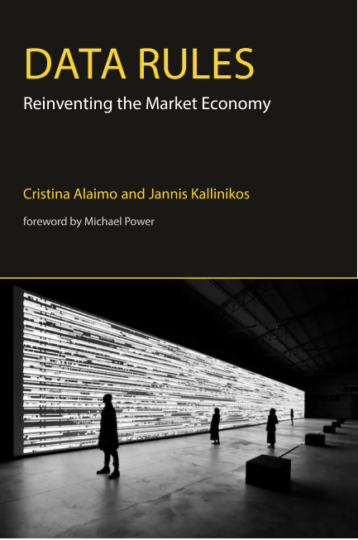
Data Rules: Reinventing the Market Economy
Working between information systems and organisation studies, the book shows how data are made, structured and valued — and how, in the process, they rewire the institutions of the market economy. It argues for data-making as a field of inquiry in its own right.
EGOS Book Award 2025 · Reviewed in the Journal of Economic Literature, The Information Society, Choice, AI & Society, R&D Management, and the Journal of Telecommunications and the Digital Economy
Data Rules not only provides a sharp definition of data but also a compelling analytical framework for studying them.
04 · Media and talks
Selected keynotes
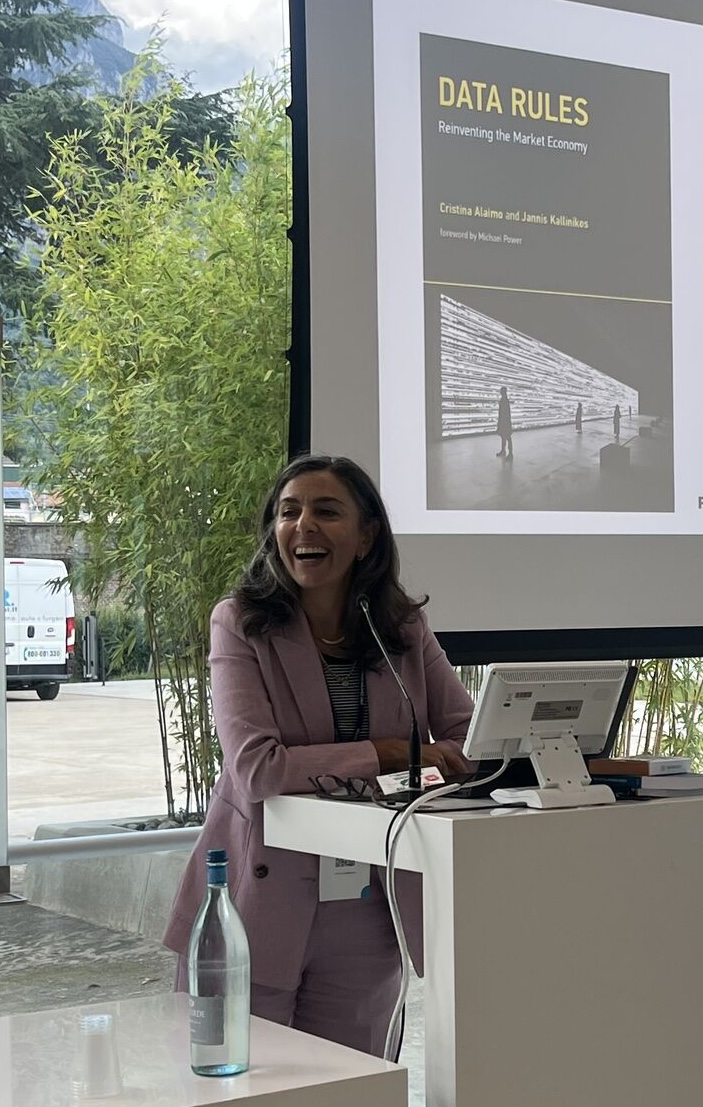
Reshaping Work: AI@Work — The Human Frontier (Amsterdam, November 2026, forthcoming) The Data–AI Nexus: Implications for Knowledge Work (EMLYON, Lyon, 2026) Learning Without Understanding: Building AI Products on LLMs (LUMSA / SIMA / BAM, 2026) Data Rules (Symplatform, Politecnico di Milano, 2025; Nordic Workshop DBOSI, LUT University, 2025) Expertise in the Digital Transformation (Weizenbaum Institute and German Sociological Association, Berlin, 2024) Data, Platforms and Automation (PLAMADISO, Weizenbaum Institute, Berlin, 2022 · video) What is the Future for Data, Economy and Responsibility? (Copenhagen Business School, 2022) Data and Organizations (Leibniz Universität Hannover, 2022) From People to Objects (Annual Lecture, Queen Mary University of London, 2022; Centre for Digital Cultures, Lüneburg, 2021).
In the media
2026 — ESSEC Knowledge Podcast: “The Nexus of Data and AI”. 2025 — Talking About Platforms Podcast, “Data, organizations and platforms” ESSEC Knowledge, Research Day 2025, “Data Rules” Thinkers50, Radar Class of 2025 ESSEC Knowledge, “ESSEC Professor Cristina Alaimo included on Thinkers50 Radar 2025”. 2024 — Il Sole 24 Ore, Luca De Biase, “I dati non sono neutrali ma ridisegnano la realtà” DisrupTV, “Are AI agents the next big thing in AI?” Outthinkers, “The hidden history of data and its role in modern strategy” The Business of Government Hour Explain to Shane, “Unpacking the data dilemma” Stack Overflow, “Datafication and socioeconomic transformations” Times Higher Education, “We need a social science of data”, with Jannis Kallinikos Fast Company, “How data is revolutionizing work and the economy”, with Jannis Kallinikos Strategy Skills, “Navigating the new data rules” KPCW Cool Science Radio, “Reinventing the market economy with data” Built In, “What are the 3 stages of the data life cycle?”, with Jannis Kallinikos DataFramed, “The history of data and AI and where it’s headed”. 2021 — Concurrences, “The value of data: are we approaching data the right way?”.
She also shares what business leaders need to know to seize new opportunities in the evolution of data and break away from traditional concepts of business.
05 · The community
Theorizing Data & AI is a European community of scholars who study data and AI as theoretical objects, not only as tools. I co-founded it in 2023 with Lauren Waardenburg.
Each year the community meets for a two-day conference — Rome in 2023, Paris in 2024, Amsterdam in 2025, London in 2026, and Crete in 2027. The conference is preceded by a doctoral workshop, where early-career researchers present work in progress to senior scholars in the field. From 2027 it is joined by a summer school in Crete, hosted by Angelos Kostis, for doctoral students working on data and AI.
The community also records conversations with leading scholars, openly publishes its reading canon, and edits special issues that carry its scientific work into academic journals. theorizingdai.com →
A scientific community that treats the data–AI nexus not as a technical backdrop but as a core analytical problem.
06 · Colophon
Contact: alaimo@essec.edu · LinkedIn · Google Scholar · ORCID
Cristina Alaimo · cristinaalaimo.com Data Rules · datarules.info Theorizing Data & AI · theorizingdai.com